
Brian Farr, the Long Way Home, and Recovery

By the time Brian Farr came to CORE in 2020, his years as an untethered drifter were finally behind him. For decades, he’d chased the next high with little concern for the future. With greying hair and weathered features, he’d been carrying the same devil-may-care attitude that had driven him since his teens. Back then, he’d skip school and fritter away entire days chasing thrills along long, circuitous paths that eventually led back to his family’s home in suburban south St. Louis County.
Nothing lasts forever. Maybe it was the weeks spent couch surfing or sleeping in his car, but something inside him had shifted. By his own admission, Brian was just done. He’d been taking the long way home his entire life—and he was tired of it. “It wasn’t fun anymore,” he says. “For a long time, even when I was getting in trouble, there were still the thrills. But not anymore. It became empty.”
In some respects, Brian was finally growing up. And when he finally got serious about recovery, he had a revelation—something he never expected: his life was just beginning.
What makes Brian’s story all the more striking is that he never seemed like a likely candidate for addiction. He grew up in a stable, middle-class family with both parents at home and three brothers. His parents—children of the 1960s—were “flower children,” as he describes them, but they instilled strong values, a belief in hard work, and a deep love for their boys. Brian even attended both Lutheran and Catholic schools. But from an early age, something in him resisted structure. He skipped school so often that during his junior year of high school, he finally dropped out.
It wasn’t long before drugs entered the picture.
At 18, his younger brother handed him a joint. “I didn’t feel much the first time,” Brian says. “But that second time? I got the giggles, the munchies—it was fun.” Within three months, he had progressed to cocaine and methamphetamine. “The obsession hit fast,” he says. “Once I got hooked, that was it. It ran my life for decades.”
Brian never fully embraced adulthood—he just went through the motions. Methamphetamines became the center of everything. Though he held a well-paying technical job in the professional printing industry, his earnings quickly vanished into his habit (as did the job). He and his longtime girlfriend—the mother of his three children—made it work for a while, but his substance use slowly unraveled their home. After 15 years, the relationship collapsed. “She stuck by me for so long,” he says. “I never got right.”
More losses followed. Brian became estranged from everyone he loved—his children, parents, and siblings. “From that point on, my life became about the drugs. For money. For everything.” At one point, he remembers staying awake for 22 straight days on meth. His mind began to unravel. “I never saw purple monkeys,” he says, “but I saw cops in trees and had full conversations with people who weren’t there.” He also began cycling in and out of the justice system.
In 2015, he suffered a brain aneurysm that impaired his speech and mobility for months. “I was so mad at the world,” he says. “I kept using.” There were a few half-hearted attempts to seek help—even one at CORE—but it wasn’t until 2020 that the moment of clarity finally came, and in the most unlikely of places.
“I was getting high with this guy I kind of recognized,” Brian recalls. “And he started quoting the Big Book—just dropping recovery language left and right. That’s when it hit me: I’d been on a detour my whole life. I told him, ‘I can’t do this anymore. I’m going back to Branson.’” That night, Brian drove back and slept in CORE’s parking lot. The next morning, our site manager, Bracy Sams, found him there.
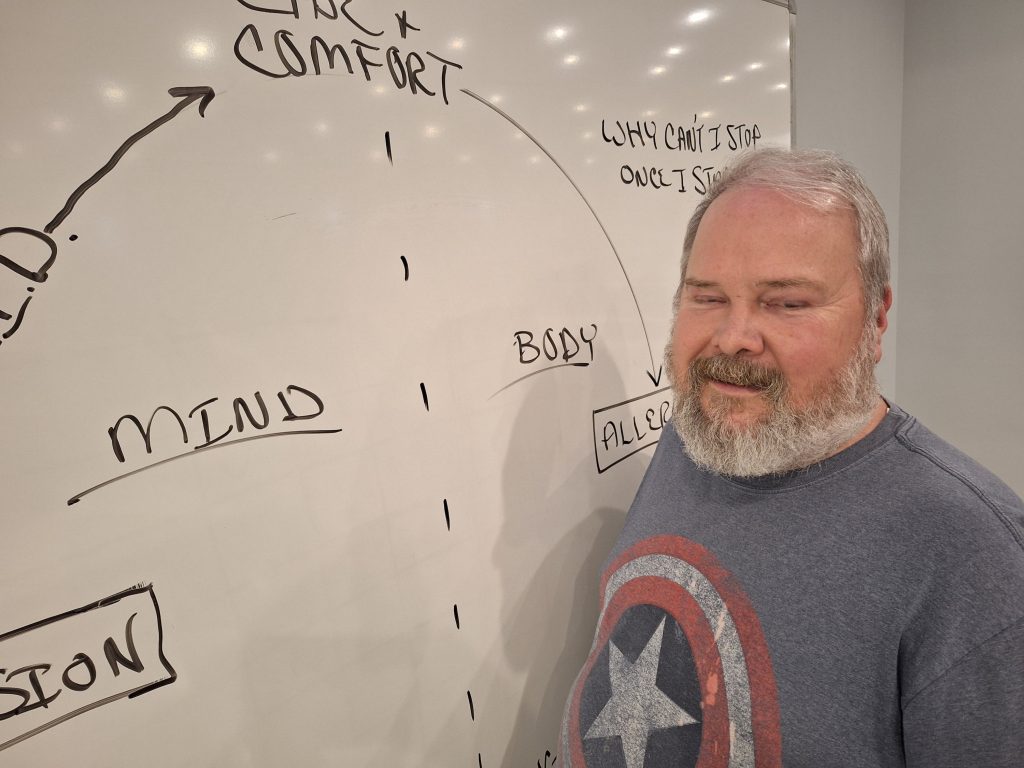
It was a humble beginning, but Brian brought with him something he’d never had before: willingness. He immediately enrolled in CORE’s CARE counseling program with Bruce Wood and began working the 12 Steps. He also embraced our recovery community and started to give back through volunteer work. The change in his outlook and attitude was nothing short of remarkable. Before long, Brian became a CORE staff member, working in the transportation department at our Branson campus.
Brian is quick to express his gratitude, especially to God. “I’m very grateful to God,” he says. “I couldn’t have done this without Him.” His recovery stayed on course even after a serious medical setback—a stroke. “They barely caught it in time,” he says. “But I didn’t use. I came straight back to CORE as soon as I could.” Although the stroke left him unable to continue working, Brian found new ways to contribute and stay productive.
He joined CORE’s 2nd Mile program, where he assists with charity and community events. “The volunteer work makes me feel better—happier,” he says. “I like being able to help people. It gives me a sense of purpose.” He also helps Branson facilities manager Tamara Spencer when able, often arriving before office hours to open the recovery center for the day.
The change in Brian is visible to everyone around him—including his family. “My parents came down for my birthday. They love me again. Well, I know they always loved me. I mean, they didn’t trust me. But now they do.” Brian has also reconciled with his children, all now young men. His oldest son has a two-year-old—Brian’s first grandchild.
His whole family looks forward to the day he returns to St. Louis, but they understand his decision to stay with CORE a little longer. When asked what’s stopping him, he gives an answer we’ve heard often from our graduates: “I’m not quite ready yet. I’ve still got some things to do here. But when I do return, I’ll still be about helping others.”
One of those things is continuing to work through the effects of his stroke. Though he’s not yet able to return to full-time work, Brian is gradually rebuilding his strength and stamina. “I’ve been able to do small things,” he says—and he’s determined to keep moving forward.
Asked where he sees himself five years from now, Brian doesn’t hesitate: “I’ll have my own place, where my kids and family can come visit me.”
He reflects on everything CORE has meant to him:
“CORE saved my life. It gave me the tools I needed to live in my own skin and be content. Today I have a great relationship with my family and my children. They respect me again. None of this would have been possible without the program.”